Enhanced Oil Recovery - Reservoir Simulation Group
# Sustainable Oil Recovery # Unconventionals # Water Reuse #Optimizing Potential
Complex Fluids - Rheology - Surface Science - Colloids and Interfaces
Surfactant-Nanoparticle Packages
-
Selection of the surfactant (Biosurfactant, Bio-based, Anionic-Nonionic, Amphoteric)
-
Selection of nanoparticle type (Colloidal silica, Solid particles, Charged particles)
-
Temperature stability (up to 150 °C)
-
Stability in brine over a long period of time (up to 300K TDS for 7 to 14 days)
-
Wettability alteration and IFT reduction studies at high temperature
Bakken reservoirs hold significant potential for surfactant EOR due to less than 8% primary recovery and billions of barrels of oil left stranded. However, the development and selection of a surfactant-nano package (SNP) is challenging for complex Bakken reservoirs, either as a completion fluid or fracfluid package, or as an EOR agent due to extremely high salinity for an unconventional reservoir (∼30% TDS) with strong presence of di- and tri-valent ions, including Fe, and high temperature ∼150 °C. Various blends of conventional (anionic, nonionic, and amphoteric), bio-based, and bio-surfactants (rhamnolipids and sophorolipids), and nanoparticle blends were examined under Bakken conditions. Formulations were screened for brine and thermal stability, as well as phase stability under Bakken conditions and corresponding changes in interfacial and surface properties were observed. Wettability alterations were assessed by contact angle using core plugs. The dosage of SNP was selected based on economic constraints, and the screening was conducted in three stages. In Stage 1, contact angle measurement, emulsion stability evaluation and interfacial property measurements were performed. In Stage 2, the stability of SNPs in Bakken brine (iron-free) at 150 °C was studied for 7 days. In Stage 3, SNPs were tested in the presence of a high concentration of Fe in brine at 150 °C. Under harsh Bakken conditions (150°C), biosurfactant-nano blend ANA (1 GPT, minimum IFT = 0.370 mN/m) and zwitterionic-nano blend CBDNA (1 GPT, minimum IFT = 0.489 mN/m) effectively reduced interfacial tension without Fe2+. When Fe2+ was introduced alongside 50% citric acid, the CSDNA formulation achieved an ultra-low IFT of 0.045 mN/m, while ANA maintained excellent long-term chemical durability (IFT = 0.21 to 0.29 mN/m over 7 days). A standalone bio-based surfactant P3 similarly exhibited robust stability against precipitation under all conditions. Furthermore, optimal treatments successfully altered shale wettability to a strongly water-wet state, yielding contact angles of 140.7° (ANA), 132.5° (CSDNA), and 151.9° (P3). Finally, demulsion tests confirmed rapid phase separation; the ANA and CBDNA blends reached complete separation (instability index = 0.5) in just 60 and 70 seconds, respectively, effectively preventing stable emulsions. Notably, all tested formulas achieved complete separation in about 5 minutes. This study provides a detailed assessment and screening of various SNPs at economic dosage thresholds for high-temperature and high-salinity Bakken reservoirs with challenging iron content. In unmitigated high-salinity environments, several biosurfactant-nano blends experienced precipitation or interfacial tension instability within a 7 days testing period. However, with the targeted application of 50% citric acid (3 GPT) and WTS (0.05 GPT), the chemical durability of optimal biosurfactant-nanoparticle blends (such as the ANA blend) was significantly enhanced, maintaining consistent, ultra-low IFT values (0.224 to 0.289 mN/m) for 7 days. It is important to note that while the 50% citric acid is valid for preventing iron oxidation and preserving fluid performance, it does not eliminate it entirely. By identifying these optimal, durable combinations, alongside inherently stable standalone options like P3, this research delivers actionable, robust chemical strategies for enhanced oil recovery in complex, iron-rich formations.
Paper Number: URTEC-4492495-MS
Viscoelastic Surfactants & Warmlike Micelles as Friction Reducers - Unconventional Reservoirs

Operational Benefits
-
Brine Tolerant
-
Compatible with produced water
-
Rapid Hydration Rate
-
Superior Friction Reduction
-
Shortens Pumping Time
-
ESG Benefits
Key Performance Benefits
-
Polymer-Free Chemistry
-
Oil-Free Formula
-
100% Water-based
-
Non-Damaging to Formation
-
Low Surface Tension
-
Enhanced Flowback
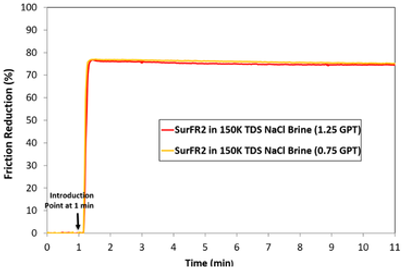
Friction Reducer with Iron Tolerant Surfactant
Conventional friction reducers precipitate in the presence of iron (Fe) from produced water. We have designed iron-tolerant surfactants that can work as friction reducers

FR-Iron: Gummy Bear Dissolution

Bio-based fatty acid surfactant for Wettability Alteration and IFT reduction

Frac-Hit Mitigation using Surfactant Foam with Diverters
Parent-child well communication in unconventional shale reservoirs originates when depleted parent fractures act as low-pressure conduits, diverting fluid and energy away from newly stimulated zones. Particulate diverters are widely used to temporarily restrict flow into these dominant pathways, yet their behavior within nitrogen foam-based carrier fluids at the pore scale is still poorly resolved. This work experimentally evaluates the role of diverting particles in stabilizing foam lamellae and promoting localized, reversible flow restriction in fracture analogues using a high-resolution microfluidic visualization platform. Experiments were conducted using a glass-etched micromodel (15 mm × 97 mm) incorporating 2 μm fracture channels and 80 nm low-permeability regions. Previously optimized foaming solutions, comprising a mixture of surfactant and nanoparticle (0.5 wt%), including hybrid surfactant–particle systems evaluated across formulations, with a low leak-off rate and nondamaging characteristics, were injected with nitrogen to generate foam films (foam quality ∼90%) at a controlled injection rate of 0.001 cc/min under an imposed pressure differential of approximately 60–70 psi. The degradable diverter particles (mean size ∼2.1 μm) were added at a concentration of 1 g per 100 mL, with corresponding variations reflected across the evaluated foam systems. The bubble size, pressure differential (ΔP), leakoff behavior, and flow redistribution in the matrix near the parent well were monitored using inline pressure transducers and a high-speed visual camera. Without divertors, foam films exhibited coarse bubble structures near constricted fracture regions (mean bubble size ∼80–90 μm; ΔP ∼60–70 psi) with high leakoff (18–25%) and persistent channeling. At 1g particle loading, bubble size reduced to ∼20–25 μm, with leakoff decreasing to ∼10–14% and improved flow resistance within the system. Over time, fine-textured foams (∼6–11 μm in smaller pore regions and ∼20–25 μm in larger pore regions) were produced, resulting in reduced leakoff (∼8–12%) and enhanced flow redistribution into adjacent regions. Pressure fluctuations within the range of 60–70 psi reflected dynamic foam restructuring and particle interaction rather than steady-state resistance. Imaging confirmed progressive particle accumulation at lamella surfaces and constricted fractures, forming transient bridging networks supported by foam films. This work provides pore-scale experimental evidence of how diverting particle-stabilized foams can temporarily restrict flow and pressure maintenance behavior in unconventional shale fracture geometries. The findings offer quantitative insight into lamella reinforcement, fracture throat bridging, and reversible plugging dynamics that support the design of particle enhanced diversion fluids for frac hit mitigation.
Paper Number: URTEC-4497630-MS
